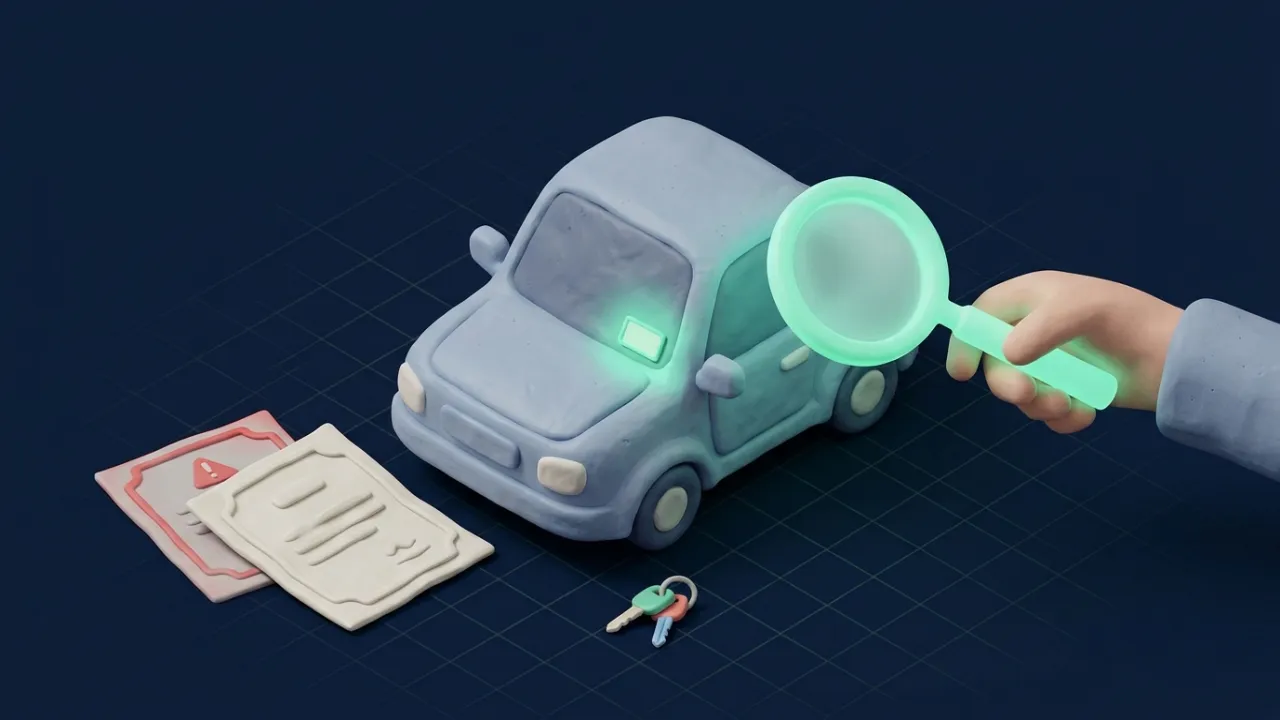
Stand at the driver's side of the car, bend down, and look through the windshield at the bottom corner where the glass meets the dashboard. There's a small metal plate with 17 letters and numbers on it, and federal rules say it must be readable from exactly where you're standing. Take a photo. Now open the driver's door and find the sticker on the door edge or the pillar it closes against. Photo two. Then ask for the title and hold it next to both.
Only buy a used car when the VIN on the dashboard, the door-jamb label and the title match character for character, the name on the title matches the seller's ID, and free checks (NICB VINCheck in the US, CPIC in Canada, the GOV.UK checks in Britain) come back clean. Never pay a deposit on a car you haven't seen.
That routine takes five minutes and catches more fraud than any app. Cloned cars, washed titles and phantom listings all depend on nobody comparing the number on the metal with the number on the paper.
How to check a VIN on a used car in five minutes
Every car and light truck sold in the US since the 1981 model year carries a 17-character vehicle identification number, printed in more places than most buyers realize:
- The dashboard plate. Federal VIN rules (49 CFR Part 565) require it to be legible through the glass by someone standing outside next to the left windshield pillar, in characters at least 4 millimeters tall.
- The door-jamb label. The manufacturer's certification sticker, which also shows the month and year the car was built.
- The paperwork. Title, registration card, insurance card and service invoices.
- Hidden stampings. Many makers also stamp the VIN, or part of it, on the engine, transmission or frame. A police or DMV VIN inspection can find them.
Look at the plate and label themselves, too. A dashboard plate should sit flat, with matching factory rivets and no scratches or glue around it. A door label that's bubbled, crooked, trimmed or sitting on fresh paint deserves a question, and so do characters of uneven height or spacing. A missing door label isn't proof of fraud, since replacement doors don't come with one, but the seller should have repair records to explain it.
Before you drive anywhere, ask for the VIN by message and run it through our free VIN check. The decoded make, model, year and engine have to match the ad. A "2019 SUV" that decodes as a 2014 sedan tells you all you need to know.
What does a VIN number tell you, and what can't it?
Part 565 splits the VIN into sections you can read yourself. The letters I, O and Q are never used, so seeing one means the number was copied wrong or invented.
| Positions | Meaning | Example: 1HGCM82633A004352 |
|---|---|---|
| 1 to 3 | Manufacturer and country | 1HG = Honda, built in the US |
| 4 to 8 | Model, body and engine | CM826 = Accord coupe, 3.0-liter V6 |
| 9 | Check digit | 3 (the math works) |
| 10 | Model year | 3 = 2003 |
| 11 | Assembly plant | A = Marysville, Ohio |
| 12 to 17 | Serial number | 004352 |
Decoded with NHTSA's vPIC decoder (2026); position meanings from 49 CFR Part 565.
The check digit is the clever part. Each character gets a value, each position a weight, and the total divided by 11 leaves a remainder that becomes position nine (X if it's 10). Mistype one character and the math almost always breaks. It's compulsory in North America and China but not in Europe, so a European import can fail the test innocently.
Here's the limit scammers count on. A VIN describes how a car left the factory, not who owns it or whether it was stolen, flooded or crashed. A cloned VIN decodes perfectly, because it's a genuine number copied from a genuine car. Decoding proves the number is real; only matching and history checks prove it belongs to this car.
What is VIN cloning and how does it work?
VIN cloning gives a stolen car the identity of a legal one. The National Insurance Crime Bureau (NICB) describes the routine: copy a VIN from a legally owned car on the street or a dealer lot, make a counterfeit VIN tag and fake ownership papers, steal an identical car, swap the tags, and sell it. It works because, as NICB notes, most licensing agencies don't check for duplicate ownership when someone surrenders an out-of-state title, and any history report on the clone shows the clean record of its legitimate twin.
Buyers usually find out when the DMV flags the VIN at registration, when police stop the car, or when the real owner starts getting someone else's tickets. Either way the car is seized and returned to the theft victim or their insurer, and the buyer is left with a receipt from a seller who has vanished.
Show as table
| Item | Value (thefts) |
|---|---|
| Hyundai Elantra | 21,732 |
| Honda Accord | 17,797 |
| Hyundai Sonata | 17,687 |
| Chevrolet Silverado 1500 | 16,764 |
| Honda Civic | 12,725 |
| Kia Optima | 11,521 |
| Ford F150 | 10,102 |
| Toyota Camry | 9,833 |
| Honda CR-V | 9,809 |
| Nissan Altima | 8,445 |
Source: National Insurance Crime Bureau, U.S. Vehicle Thefts Experience Historic Decline (March 2026).
Clones tend to be common models, because there are plenty of identical legal cars to borrow numbers from. To beat one, do the full matching, check that the title was issued in the state where the seller lives, and follow two NICB tips: be wary of a late-model car with no lienholder, since most newer cars are financed, and ask your insurer to inspect the car before you buy. A title issued days ago in another state, on a two-year-old car with no loan, from a seller who won't meet at home, is the classic clone profile.
How to check if a car is stolen, by VIN or license plate
In the US, start with NICB's free VINCheck. It shows whether a VIN has been reported stolen and not recovered, or reported as salvage or flood-damaged, by NICB member insurers, which NICB says represent 92.49% of earned insurance premium. You get five searches per 24 hours per IP address. Its fine print matters: it checks insurance records only, not police records, and NICB says it shouldn't be the only thing you rely on. Many police departments will also run a VIN or inspect a car at the station if you call the non-emergency line first. A seller who won't meet there has answered a question for you.
Can you check by license plate? In the US, mostly not. Public tools run on the VIN, and the federal Driver's Privacy Protection Act restricts who can pull owner details from a plate. Get the VIN, then confirm the registration card shows both that VIN and the plate on the car.
United Kingdom
British checks run on the registration plate. GOV.UK tells buyers to get the registration number, make, model and MOT test number, then check the details against DVLA's records, the MOT history and safety recalls, all free. The V5C log book should carry a "DVL" watermark; if its serial number falls between BG8229501 and BG9999030, or BI2305501 and BI2800000, it may be stolen and you should call the police. The VIN and engine number must match the log book. Stolen markers and outstanding finance aren't on the free government services, so buyers pay a private history-check company for those.
Canada
The RCMP's Canadian Police Information Centre runs a free search at cpic-cipc.ca that checks a VIN against police stolen-vehicle records. A positive result means you contact local police to confirm. CPIC won't show liens; in Ontario, the seller must give you a Used Vehicle Information Package, which shows whether money is owed on the car.
Show as table
| Week of | Vehicles reported stolen |
|---|---|
| 2,020 | 880,595 |
| 2,021 | 932,329 |
| 2,022 | 1,008,756 |
| 2,023 | 1,020,729 |
| 2,024 | 850,708 |
| 2,025 | 659,880 |
Source: NICB, U.S. Vehicle Thefts Experience Historic Decline (2026) for 2025; NICB data reported by Claims Journal (2025) for 2020 to 2024.
NICB counted 659,880 vehicles stolen in 2025, down 23% from 2024 and far below the 2023 peak of just over a million. That's still one vehicle every 48 seconds.
What is title washing? Salvage, rebuilt and flood titles
When a car is badly damaged, the state usually adds a "brand" to its title. The Justice Department's National Motor Vehicle Title Information System (NMVTIS) defines a brand as a label showing a vehicle's current or prior condition. Names and thresholds vary by state, but broadly:
| Brand | Usually means | For you |
|---|---|---|
| Salvage | An insurer declared it a total loss | Can't be driven until repaired and inspected |
| Rebuilt | A salvage car repaired and passed inspection | Legal, but worth much less and harder to insure |
| Flood | Water reached the cabin or engine | Electrical faults can appear months later |
| Junk | Fit only for parts or scrap | Should never be sold as a working car |
Title washing removes the brand by moving the car. NMVTIS explains that a brand gets "washed" when a car is retitled in a state that doesn't check with the states that titled it before. Its consumer page cites an Experian Automotive count of more than 185,000 titles washed in just the first half of 2008, the gap NMVTIS was built to close: once a state reports a brand, it stays on that car's record permanently.
An NMVTIS report, sold by approved providers listed on vehiclehistory.bja.ojp.gov, covers the title and brand history, the latest odometer reading, insurer total-loss findings, junk or salvage-yard transfers and sometimes theft. The program admits its gaps: 87% of US vehicles are in the system, but until every state and insurer reports as required, a search can return a false "no salvage history."
How to tell if a car has been in a flood
After big storms, flooded cars are written off, sold at salvage auctions, and some come back looking spotless. NMVTIS recalls that after Hurricane Katrina, truckloads of flooded cars left Louisiana for states as far away as the upper Midwest, where they were dried out and sold. Distance from the storm is part of the con. Start with your nose: a musty smell, or heavy air freshener hiding one, means keep looking. Then check where NICB tells buyers to look:
- Stains, mildew, sand or silt under carpets, in the headliner, behind the dash and inside seatbelt retractors (pull a belt all the way out).
- Faded upholstery, warped door panels and crackling door speakers.
- Rust on screws and seat rails where water doesn't normally sit.
- Mud in the spare-tire well, alternator crevices, starter motor and relays.
Why care if it drives fine? NICB warns that flood water attacks wiring, sensors and computer modules that can fail years later, can stop airbags from deploying properly, and corrodes brake lines and fuel systems. A flood car can even carry a clean title if the owner had no insurance and never made a claim, so get a mechanic's inspection.
Odometer rollback: how to check the mileage is real
Mileage fraud didn't die with mechanical odometers. NHTSA says tampered digital odometers are even harder to spot, because there are no moving parts to misalign.
Source: NHTSA, Odometer Fraud (2026).
NHTSA's checklist: compare the title mileage with the odometer, and look hard at a smudged figure. Compare the odometer with service and inspection records, and hunt for oil-change stickers on the windshield, door frame and under the hood. A car showing 20,000 miles or less should still have its original tires. Pedal wear should fit the mileage. A shiny, worn steering wheel on a car showing 30,000 miles doesn't add up either.
Sellers must write the mileage on the title, though NHTSA notes cars 20 years old or older, or model year 2010 or older, are exempt. Report suspected rollback to your state's enforcement agency, or to NHTSA's Vehicle Safety Hotline on 888-327-4236 for large-scale schemes. In the UK, MOT history records the mileage at every test since 2005.
Facebook Marketplace and Craigslist car scams
The most common private-listing scam is the car that doesn't exist. The FBI's Internet Crime Complaint Center (IC3) received about 26,967 complaints of fraudulent online vehicle sales from May 2014 to December 2017, with adjusted losses of $54,032,396. Its warning described ads with copied photos, prices well below market, and a cover story: the seller is moving or being deployed, it's a divorce settlement, or it belonged to a relative who died. Buyers were told a big marketplace's "buyer protection program" covered them, then asked to pay with gift cards.
Every line is a warning: no viewing, a cover story, a deposit, a shipper the seller picked, and a fake inspection period. Other patterns to know:
- The verification code. Someone texts you a code and asks you to read it back. The FTC says scammers use it to set up a Google Voice number tied to your phone. Sharing a code with someone who contacted you is a scam every time.
- Fake payments when you're selling. NICB describes buyers who pay with a counterfeit cashier's check or a wire that gets recalled, then drive off with the car.
- Payment apps, gift cards or crypto. None of them protect you when you pay a stranger for something you haven't received.
Curbstoners: dealers pretending to be private sellers
A curbstoner is an unlicensed dealer posing as a private owner, often selling wrecked, rolled-back or stolen cars. Maryland's Motor Vehicle Administration lists the giveaways: the same phone number on several cars, meeting anywhere but home, chatting only inside the app, insisting on cash, offering to handle the title paperwork, temporary or dealer plates, and a title that's recently issued, altered or not in the seller's name. If the seller isn't the person on the title, you're not buying from the owner.
Fake escrow and vehicle shipping scams
This often follows the phantom-car pitch. The distant seller suggests a "safe" deal: you pay an escrow service, a shipper delivers the car, and you get days to inspect before the seller is paid. The escrow site looks professional, with live chat and a phone line, and wants a wire transfer. The escrow company, the shipper and the car are all invented.
Real escrow works the other way around. You choose the service, find it yourself, and confirm it's licensed with a long, checkable history. A seller who insists on one particular escrow company is the scam. Run any unfamiliar site through our website checker; our fake online store guide shows how to spot cloned and brand-new sites. A real interstate car hauler or broker also has a USDOT number you can look up in the Federal Motor Carrier Safety Administration's public records.
Is a free VIN check reliable? Free vs paid checks compared
Free checks are reliable for what they cover, and none covers everything. A clean result means no record was found, not that nothing happened.
| Check | Cost | Shows | Misses |
|---|---|---|---|
| LegitInformant VIN check | Free | Decoded details, check digit, model recalls | Theft, accidents, title brands |
| NHTSA recall lookup | Free | Unrepaired recalls on that VIN | Everything else |
| NICB VINCheck | Free, 5 a day | Unrecovered theft, insurer salvage and flood | Police records, odometer, brands |
| NMVTIS report | Small fee | Title brands, last odometer, total losses | Repairs, minor accidents |
| Commercial report | Paid | Reported accidents, service visits, owners | Anything never reported |
| UK GOV.UK checks | Free | DVLA details, MOT results and mileage | Stolen markers, finance |
| Canada CPIC | Free | Police stolen records | Liens, history |
For most private sales, stack free decoding, VINCheck (or CPIC, or GOV.UK), one paid history report and an independent mechanic. Open recalls stay with the car, and our product recalls guide explains free recall repairs. Fake replacement parts are covered in our counterfeit products guide.
How to pay for a used car safely and do the paperwork
The money, the keys and a correctly signed title should change hands at the same moment, somewhere fraud is hard.
- Meet at a bank or DMV office. Banks can verify funds; DMV and tag offices can confirm the title on the spot.
- Match the people to the paper. The seller's driver's license must match the owner on the title. If a lienholder is listed, get a lien release or pay the lender directly.
- Pay with something traceable. A cashier's check from your own bank, or a transfer done at the branch. Selling? NICB advises calling the issuing bank to verify a cashier's check, meeting at the buyer's bank, and waiting two business days after a wire to confirm it arrived.
- Sign the title cleanly. Fill in every field, including mileage, with no erasures. Maryland's MVA treats an altered title as a red flag.
- Get a bill of sale. Ontario requires the seller's name, the buyer's name and address, the date and the price. Add the VIN, mileage and both signatures.
- Register it promptly. In the UK, tax the car immediately using the green new keeper slip from the V5C.
The money, the keys and a signed title should change hands in the same minute, not the same week.
Already sent a deposit to a stranger? Contact your bank or payment app today, then use our recovery planner; for Zelle, Cash App and bank transfers, see what to do after sending money to a scammer. Keep every message and receipt, and use our reporting page to tell the FBI's IC3 and the FTC. If the car you bought is seized as stolen, file a police report and give investigators everything you have on the seller.
Frequently asked questions
Can two cars have the same VIN?
Not legitimately. Each VIN is assigned once by the manufacturer under federal rules, and the last six characters work as a unique serial number. If two cars on the road carry the same VIN, one of them is almost certainly a clone: a stolen car wearing a copied plate and forged paperwork. Very old vehicles built before 1981 used shorter, non-standard numbers, which is the only common case where odd duplicates turn up.
What does it mean if the VIN on the door doesn't match the title?
Stop the sale until you understand why. A mismatch can mean the dashboard plate or door label was swapped onto a stolen car, or that the title belongs to a different vehicle. There are innocent explanations, such as a replacement door from a salvage yard that still carries its old label, but the seller should be able to prove it with repair records. A police or DMV VIN inspection settles it.
Is a clean vehicle history report a guarantee?
No. A history report lists only what was reported to the companies and agencies behind it. Accidents paid in cash, repairs at independent shops, floods on uninsured cars and records from states or insurers that don't report can all be missing. Treat a clean report as one piece of evidence, then add a pre-purchase inspection by an independent mechanic and a careful look at the title and the seller's ID.
Does a VIN show accident history?
The VIN itself doesn't. Decoding it tells you only how the car left the factory: maker, model, year, engine and plant. Accident history comes from databases that use the VIN as a search key. NICB VINCheck shows insurer total losses, NMVTIS shows title brands and insurer salvage reports, and paid commercial reports add police-reported crashes and service records where available. Minor accidents that never involved an insurer may appear nowhere.
Is it safe to share my car's VIN when I'm selling?
Generally yes. The VIN is printed under the windshield where anyone walking past can read it, and honest buyers need it to run checks. The risk is that VINs are what car cloners copy, so don't post photos of your title or registration online. Share the VIN with serious buyers by message, keep the title itself private, and never share any verification code a buyer texts you.
Why does a car show as a total loss when it looks perfect?
A total loss is an insurance decision, not a description of the car. According to the Justice Department's NMVTIS consumer guidance, insurers may declare a stolen car a total loss if it isn't recovered within about 30 days, and that record stays even if the car turns up undamaged. Hail, flood and theft damage can also total a car that later looks fine. Ask for the claim history and get an inspection.
Are older cars exempt from odometer disclosure?
Yes, partly. NHTSA says a vehicle is exempt from the federal written mileage disclosure if it's 20 years old or older, or a model year 2010 vehicle or older. On those cars the seller doesn't have to certify the mileage on the title, so service records, inspection reports and MOT-style history matter even more. Rolling back an odometer is still illegal on any car.
What if the seller says the title is lost?
Walk away until a replacement title arrives. A real owner can order a duplicate title from their state DMV, usually for a small fee, and a car with money owed on it may have its title held by the lender. Buying with only a promise to mail the title later is how buyers end up with stolen, cloned or liened cars they can never register.
Can I get my money back if I bought a stolen car?
Usually not from the car. A stolen vehicle goes back to its owner or the owner's insurer, even if you paid a fair price in good faith. Your claim is against the person who sold it, so file a police report, give investigators every message, photo and receipt, and tell your own insurer. A consumer lawyer or small-claims court may help if the seller can be found.
What should a bill of sale include?
At minimum: the seller's and buyer's full names and addresses, the date, the price, the full 17-character VIN, the year, make and model, and the odometer reading, with both signatures. Ontario lists the names, buyer's address, date and price as required. Adding the words "sold as is" and the seller's driver's license number helps if anything goes wrong later.
Sources
- NICB: U.S. Vehicle Thefts Experience Historic Decline (2026)
- Claims Journal: NICB data, U.S. vehicle thefts decreased by 17% in 2024 (2025)
- NICB: VINCheck lookup, free vehicle history check (2026)
- NICB: Buying a used vehicle, cloning, flood and online sale scams (2026)
- NHTSA: Odometer fraud (2026)
- eCFR: 49 CFR Part 565, Vehicle Identification Number requirements (2026)
- NHTSA: vPIC VIN decoder (2026)
- U.S. Department of Justice: NMVTIS for consumers (2026)
- FBI IC3: Fraudulent online vehicle sales, PSA 180117 (2018)
- FTC: Google Voice scam, how the verification code scam works (2021)
- Maryland MVA: Unlicensed dealers commonly known as curbstoners (2025)
- GOV.UK: Check a used vehicle you're buying (2026)
- RCMP Canadian Police Information Centre: Search vehicles (2026)
- Government of Ontario: Buy or sell a used vehicle in Ontario (2026)
Figures are the latest available from each source at the time of writing. We review guides when official data or rules change. Spotted an error? Tell us.